
A practical, emotionally grounded guide to sorting out post-separation debt, protecting cash flow, and rebuilding one clear step at a time.
The debt is not your identity
There is a specific, heavy feeling that can come with debt after a separation. It is not just financial. It is emotional, personal, and often tied to grief, fear, anger, uncertainty, and pure exhaustion.
You log into your banking app and see a negative balance. Credit cards are higher than you expected. Legal fees keep adding up with every email. Maybe debt that used to feel shared now feels like yours alone to carry.
In those quiet moments, the numbers can stop feeling like numbers. They can start sounding like a personal judgment:
· I completely messed up my life.
· I should have seen the warning signs.
· How did I let myself get here?
This is the trap of post-separation finances. A balance on a screen can start to feel like a story about your worth. But a negative balance does not make you a negative person. Debt is a math problem that needs a timeline. It is not a verdict on your character, your future, or your ability to rebuild.
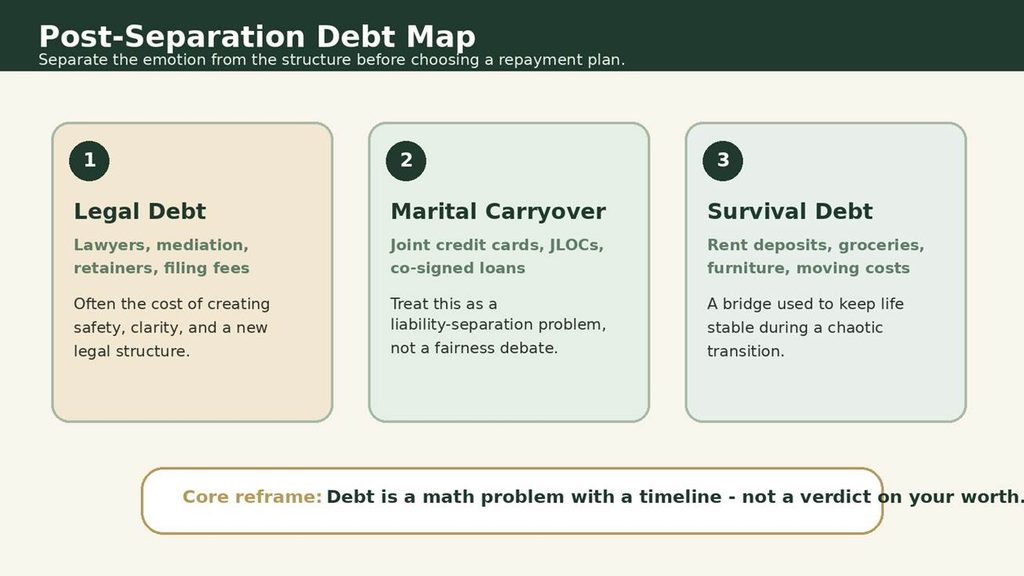
Infographic: Post-separation debt becomes easier to manage when it is separated into practical categories.
The core shift: from shame to structure
Debt that builds up during a separation is often caused by the situation itself, not by poor character or a lack of effort. Legal fees, two households, moving expenses, frozen accounts, delayed support payments, and unclear joint liabilities can all hit at the same time.
The most important shift is this: stop treating debt like a moral failure and start treating it like a problem that needs structure. Shame leads to avoidance. Structure gives you options.
| ReframeThis debt may be part of the story of what it cost to get through a destabilizing chapter. It does not have to become the story of who you are. |
Breaking it down: three types of post-separation debt
| 1. Legal debt | 2. Marital carryover | 3. Survival debt |
| Lawyers, retainers, court filings, mediation fees, and payment plans. This is often the structural cost of legally separating and creating a safer next chapter. | Joint credit cards, shared lines of credit, car loans, or co-signed balances. These need liability separation, not just an emotional fairness debate. | Groceries, rent deposits, utilities, moving trucks, childcare gaps, or essentials bought while life was unstable. This is often a bridge, not a budgeting failure. |
Try not to lump everything into one scary total right away. First, understand what each balance actually represents. Then decide what needs legal separation, what needs repayment prioritization, and what needs a realistic cash-flow plan.
Example: Carla’s survival bridge
After her separation, Carla went through a very difficult ninety-day period where her household income dropped by roughly 60%. She used her credit card for groceries, utilities, and basic supplies for her children. At first, she saw the balance as proof she had failed.
Once she separated the debt into categories, the story changed. This was not lifestyle debt. It was survival debt. She had used credit as a temporary bridge to keep her household stable. That did not erase the balance, but it did remove the shame that was making it harder to face.
Why panic is your most expensive mistake
Debt can make everything feel urgent. But urgent feelings do not always lead to the best financial decisions. Panic can push people to avoid statements, accept payment terms they cannot sustain, borrow at worse rates, or fight expensive legal battles for emotional relief instead of practical progress.
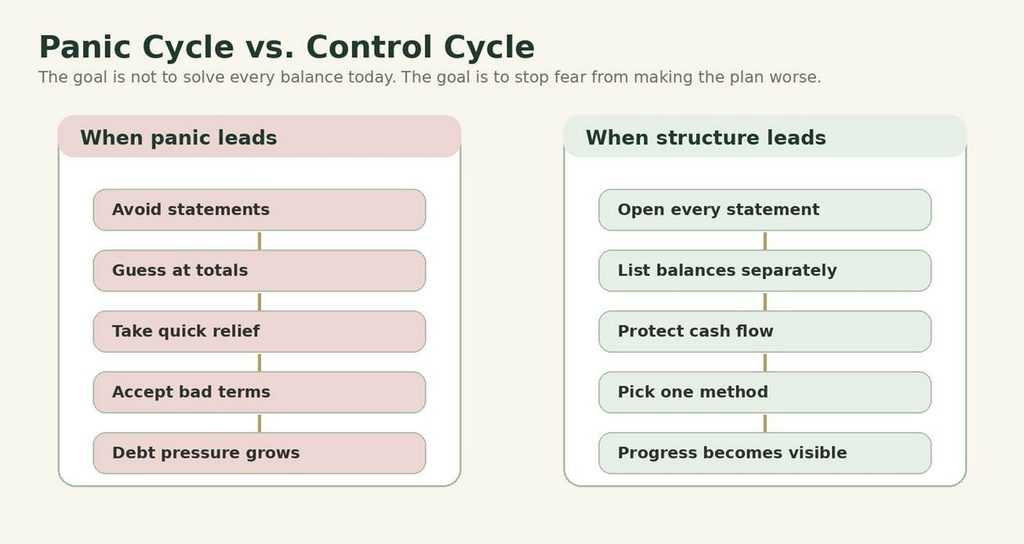
Infographic: Panic multiplies pressure. Structure creates a repeatable next step.
| Two common panic trapsThe emotional house trap: fighting to keep a home that no longer fits the new income picture can leave someone house poor and cash poor.The credit score obsession: a temporary score dip is often less urgent than separating liability and stabilizing cash flow. |
The audit: face the numbers without the noise
Before making extra payments, create a clean debt list. Do not start with one overwhelming total. List every liability separately so each balance can be handled with the right strategy.
| Creditor / debt | Category | Balance | Interest rate | Minimum payment |
| Legal firm retainer | Legal | $6,500 | 0% payment plan | $250/month |
| Shared Visa card | Marital carryover | $4,200 | 21.99% | $120/month |
| Personal line of credit | Survival / transition | $3,200 | 9.50% | $75/month |
| Moving expenses card | Survival | $2,100 | 19.99% | $65/month |
Once the information is visible, the debt often feels less frightening. It may still be serious, but it is no longer vague or endless. It has names, rates, payments, and possible timelines.
Example: Jason’s ‘infinite’ debt became finite
Jason was convinced his debt was impossible. Because he had avoided the statements for months, his mind filled in the blanks with worst-case numbers. When he finally built a debt list, the total was about $16,000: two credit cards, a legal balance, and a line of credit. It was not easy, but it was knowable. Once it was knowable, he could make a plan.
Four post-separation blind spots to watch for
| Requalification shockA separation agreement may say one person keeps the home, but the lender still needs to approve that person based on solo income, debt service ratios, and current lending rules. | Zombie joint accountsOld joint credit cards, store cards, or lines of credit can remain open unless they are frozen, closed, or changed to require both signatures. |
| The solitary household multiplierRunning one household alone can be more expensive than expected because property tax, utilities, groceries, insurance, and repairs are no longer shared. | The RRSP tax trapWithdrawing RRSP funds to pay debt can trigger tax and permanently lose contribution room. Get advice before using registered assets in a separation context. |
Five rules for regaining financial control
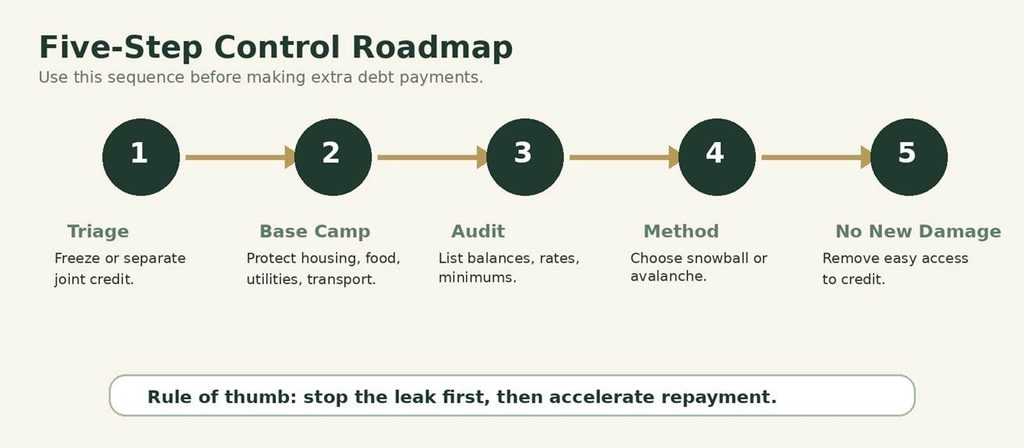
Infographic: The sequence matters. Stabilize first, then accelerate.
1. Perform financial triage first
Separate joint and individual finances before making aggressive payments. Pull credit reports from both Equifax and TransUnion, identify every shared liability, and contact financial institutions to freeze, close, or require two signatures on joint credit where possible.
2. Secure your base camp
Protect the basics first: housing, food, utilities, insurance, childcare, and transportation. A debt plan that leaves no room for real life usually pushes people right back into credit.
3. Choose one repayment method
Use the debt snowball if early wins will help you stay motivated. Use the debt avalanche if you want the most mathematically efficient route and can stay consistent. The best method is the one you can realistically follow for the next six months.
4. Lower the temperature on legal fees
Do not ignore legal bills. Ask whether a structured monthly payment plan is available. Many firms are used to working with clients who are navigating financial transitions.
5. Enforce a no-new-damage policy
Stop the bleeding. Remove saved cards from online accounts, keep credit cards out of daily reach, and use debit or cash for discretionary spending while the plan stabilizes.
Snowball or avalanche? A practical example
| Method | How it works | Best fit |
| Debt snowball | Pay minimums on everything, then put extra money toward the smallest balance first. | Best when motivation, confidence, and early progress matter most. |
| Debt avalanche | Pay minimums on everything, then put extra money toward the highest interest rate first. | Best when reducing total interest cost is the priority and you can stay consistent. |
| Example decisionIf a client has a $900 store card, a $4,200 Visa, and a $6,500 legal balance, the snowball may start with the $900 card to build momentum. The avalanche may start with the Visa if it has the highest interest rate. Neither approach works without stable cash flow first. |
A simple 30-day reset plan
| Week 1 | Week 2 | Week 3 | Week 4 |
| Pull credit reports. List every account. Mark joint vs individual. | Freeze or close joint credit where possible. Confirm minimum payments. | Build a one-month survival budget and choose snowball or avalanche. | Automate minimum payments, track one weekly win, and review progress. |
This is a season, not a sentence
Rebuilding after separation is rarely a straight line. Some months will feel slow. Unexpected expenses may still come up. That does not mean the plan has failed. Financial recovery is less about doing everything perfectly and more about staying consistent.
Post-separation debt can carry a lot of guilt, anger, grief, and fear. But it can also be seen as a record of a chapter where you had to make hard choices under pressure. It may show what it cost to get through the transition. It does not have to define what happens next.
Example: Daniel’s financial reset
Daniel left his marriage with credit card debt and legal fees. For months, he avoided the mail because every envelope felt like proof of failure. His turning point came when he changed the rule: “I am allowed to have debt. I am not allowed to avoid it.”
He opened the statements, automated minimum payments, and used the snowball method. The debt did not disappear overnight, but the fear started to shrink because he had a process. His confidence started to come back before the balances were fully gone.
| Closing messageYou are not behind forever. You are not ruined. You are rebuilding. Rebuilding can feel messy in the middle, but it moves forward one clear, calculated step at a time. |
Client checklist: debt after separation
· I have listed every debt separately.
· I know which debts are joint and which are individual.
· I have pulled or requested both Equifax and TransUnion credit reports.
· I have contacted institutions about freezing, closing, or restricting joint accounts.
· I know my baseline monthly survival costs.
· I have chosen either snowball or avalanche for the next six months.
· I have a no-new-damage rule for discretionary credit use.
· I have asked for advice before withdrawing registered assets or changing mortgage debt.
| Important noteThis article is for general educational purposes. Separation can involve legal, tax, credit, and lending issues. Readers should speak with qualified legal, tax, mortgage, and financial planning professionals before making major decisions. |
— Sabiha

Meet The Author
Hi, I’m Sabiha Mukadam— a Fee-for-Service Financial Planner, Senior Manager, and lifelong advocate for financial confidence. With more than three decades of global experience across banking, investments, credit, and corporate finance, I’ve dedicated my career to helping people feel empowered and in control of their financial future.
I have been a Senior Planner and now Partner with Ed for the past 8 years. My journey has taken me through roles at TD Asset Management, RBC, and Barclays Bank of Zambia, giving me a broad perspective on how financial systems operate across markets. I hold the CFP® designation, an MBA in Finance and Corporate Governance, and multiple credentials across insurance, securities, and financial advice.
I teach financial planning and banking at the college level and have proudly mentored newcomers and young professionals entering the industry. For me, financial planning is about people—their stories, values, and dreams. When we work together, you can expect thoughtful conversations, practical guidance, and a plan centered entirely around what matters most to you.
Thank you Sabiha!
I’m in the survival phase now and dealing with many of the issues you itemized in the this piece.
Your article is compassionate and very good advice.
I wish I had read this four years ago!
I look forward to reading your future articles.
Thank you so much for your kind words. I’m sorry to hear that you’re in the survival phase right now, but I’m glad the article resonated with you and hopefully offered some reassurance as you work through it.
Sometimes we only come across the right information once we’re already in the middle of the experience. Please know that you’re not alone in navigating these challenges, and I hope some of the ideas in the article can still be helpful as you move forward.
Thank you again for taking the time to write to me. I truly appreciate it, and I hope you find the upcoming articles just as valuable.
Sabiha